Claude AI Recovers $400,000 in Bitcoin After Owner Forgot His Password for 11 Years

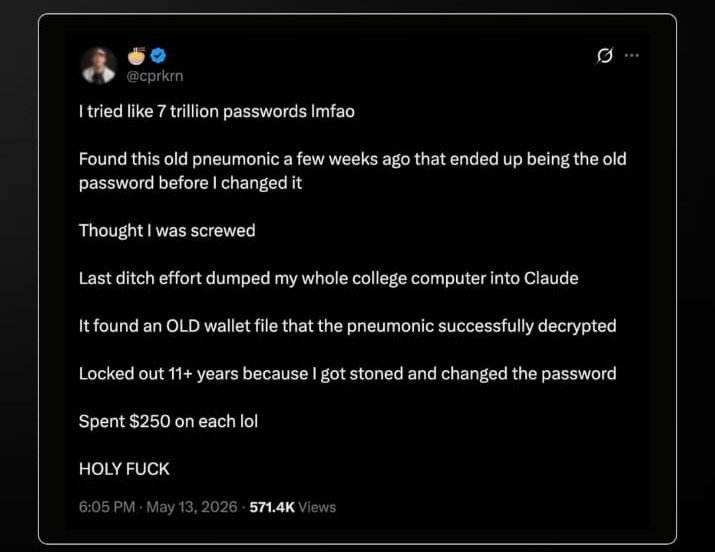
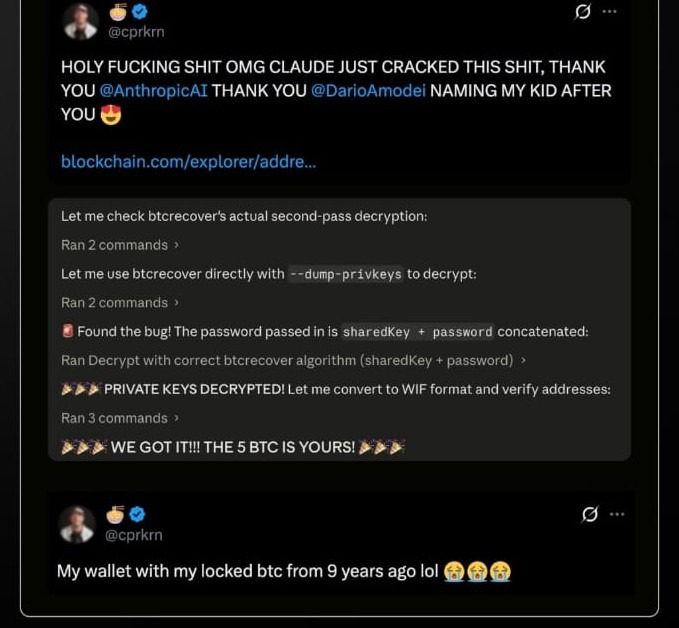
A decade-old cryptocurrency nightmare has ended in one of the most talked-about wins for artificial intelligence this year. An anonymous Bitcoin holder, posting on X under the handle @cprkrn, said he has finally recovered roughly 5 BTC — valued at close to $400,000 at current prices — after eleven years of being locked out of his own wallet. The breakthrough did not come from a paid recovery firm or any specialized cracking software. It came from Anthropic's general-purpose AI assistant, Claude.
The recovery has been independently covered by major technology outlets including Tom's Hardware, Decrypt, CoinDesk, and Bitcoin.com News, with the original screenshots and transaction proofs verified on the public blockchain.
A College Mistake That Aged Into a Six-Figure Loss
According to the user's own account, the wallet dates back to roughly 2014 or 2015, when Bitcoin was trading at around $250 per coin. As a college student at the time, he purchased 5 BTC for about $1,250 and stored them in a Blockchain.com wallet.
One evening, while intoxicated, he changed the wallet's password to something he found amusing in the moment. By the next morning, the new password was already gone from memory.
For years it felt like a minor regret. But as Bitcoin's price climbed through multiple bull cycles, that small loss compounded into a financial wound that grew harder to ignore. By 2026, with Bitcoin trading near $79,000, those forgotten coins were worth close to $400,000.
Eight Weeks, 3.5 Trillion Passwords, and No Progress
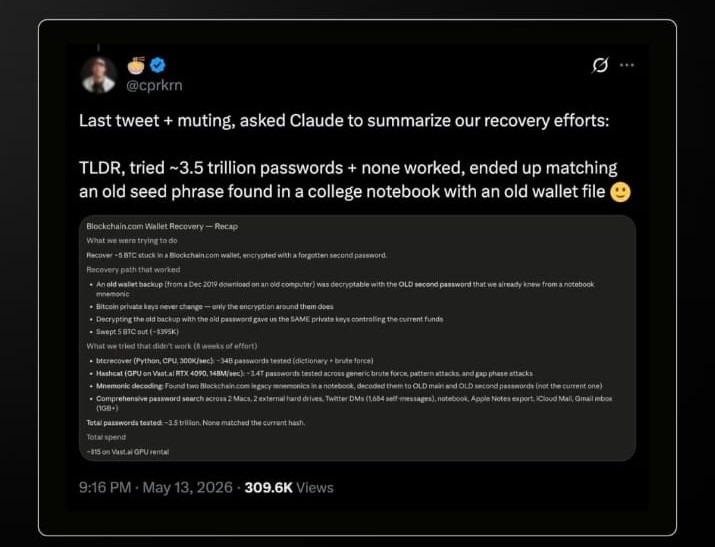
Before he turned to Claude, @cprkrn spent more than a decade attempting recovery through conventional means. The final eight-week sprint alone, by his own published breakdown, involved an extraordinary amount of compute:
- btcrecover running on CPU at around 300,000 attempts per second tested roughly 34 billion dictionary and brute-force combinations
- Hashcat running on a rented RTX 4090 GPU on Vast.ai burned through about 3.4 trillion combinations across brute force, pattern, and gap-phase attacks
- He decoded two older Blockchain.com mnemonic phrases from his notes, but they only matched older passwords — not the current one
- He combed through two Mac computers, two external hard drives, 1,684 Twitter self-DMs, Apple Notes exports, an iCloud Mail archive, and a Gmail archive of over a gigabyte
- Total GPU rental spend was reported at about $15
- In all, approximately 3.5 trillion candidate passwords were tested. None worked.
At that point, with every traditional avenue exhausted, he decided to do something most users would never think to try: hand his entire archive of old college files to a general-purpose AI and ask it to find a way in.
What Claude Actually Did
The shift in approach changed everything. Instead of trying to guess a password that the user had clearly forgotten beyond recovery, Claude focused on the data the user already had. By scanning years of files from the old college computer, the AI surfaced an older wallet backup from December 2019 — a copy of the wallet that predated the disastrous password change.
This older backup was the key, in more ways than one. Because Bitcoin private keys themselves never change — only the encryption protecting them does — successfully opening the older backup would yield the very same keys that controlled the current funds. The coins on the blockchain had never moved. The user simply needed a version of the wallet that an older password could still unlock.
That older password, as it turned out, had been written down years earlier as a mnemonic phrase in a college notebook. @cprkrn had rediscovered it weeks before but had no way to connect it to a working wallet file — until Claude found the right backup.
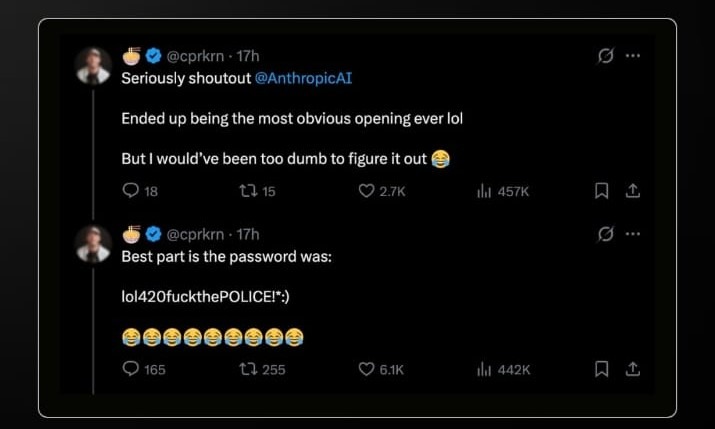
The password itself, once revealed, was almost comically obvious in hindsight: a chaotic mashup of numbers, profanity, and an emoticon, exactly the kind of string that no automated tool would ever stumble onto without a hint. The user himself joked that he would have been "too dumb to figure it out" without help.
The Genuine Technical Win: A Bug Inside the Recovery Tool
Even with the right backup file and the right password, the recovery still didn't succeed at first. This is where Claude's contribution moved beyond simple file-sorting into something more substantive.
The widely used open-source utility btcrecover was passing the password into the decryption routine in the wrong order. The correct format required the shared encryption key to be concatenated with the password in a specific sequence, but the tool was getting the order reversed in this particular wallet's case. The failure was silent — every attempt simply looked like another bad password, with no error to point at the real cause.
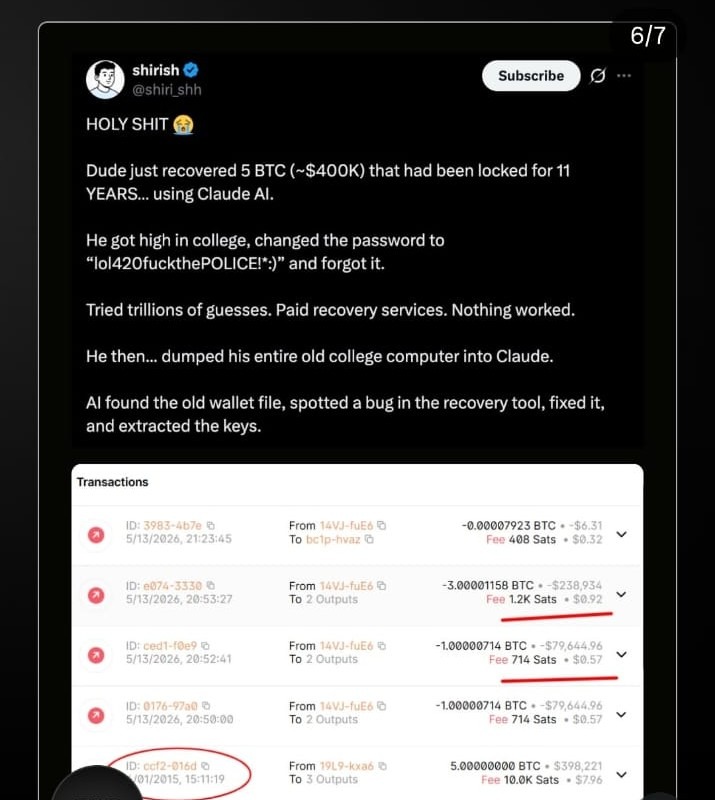
Claude identified the concatenation bug, rewrote the decryption logic to match the correct algorithm, re-ran the process, and successfully extracted the private keys in Wallet Import Format. The recovered keys matched the target address exactly. The 5 BTC, untouched on a legacy P2PKH address since April 1, 2015, were swept out to a new, secure wallet the same day.
A Viral Moment for Anthropic
The reaction from @cprkrn was, predictably, ecstatic. He publicly thanked Anthropic and CEO Dario Amodei, joking that he intended to name his future child after the company's chief executive. The post quickly racked up millions of views and turned into one of the most-shared AI-related stories of the month.
For Anthropic, the moment landed at a useful time. The company has spent much of the past year positioning Claude as a serious tool for technical and analytical work rather than a casual chatbot. A real-world story of an AI assistant debugging an open-source tool, navigating years of digital clutter, and ultimately returning a six-figure sum to its owner is exactly the kind of demonstration that no marketing campaign can engineer.
What This Recovery Is — and What It Isn't
In the rush of attention, several social media posts framed the story as if Claude had somehow broken Bitcoin's encryption. It did not, and the distinction is important.
As outlets including Decrypt and CoinDesk emphasized in their coverage, Bitcoin's underlying cryptography was never compromised. The user already possessed the correct historical password, embedded in an old notebook mnemonic. The wallet file that the password could unlock already existed on his hard drive, just buried under a decade of unrelated data. What Claude did was three concrete things:
- It located the right historical backup among thousands of files.
- It identified a real bug in the recovery tool that had been silently failing every attempt.
- It executed the corrected decryption process end to end, freeing the private keys.
That is not a cryptographic breakthrough. It is something arguably more useful for ordinary people: AI as a forensic research assistant capable of working across messy, multi-format personal archives and contributing real engineering insight when a tool isn't behaving correctly.
Lessons for Anyone Holding Crypto
For Bitcoin holders watching this story, especially those with old wallets they have given up on, there are several practical takeaways:
- Recovery phrases deserve serious backup. Paper alone is fragile; combining a paper copy with a metal plate or encrypted digital storage is the modern standard. Memory is not a backup strategy.
- Old files should be preserved, not deleted. The single piece of data that made this recovery possible was a wallet backup the owner had not thought about in seven years. Hard drives and laptops from earlier eras can hold keys to wallets users have already mentally written off.
- AI assistants are now a legitimate part of the recovery toolkit. They will not break cryptography, and they cannot conjure missing information out of nothing. But they can sort, correlate, and debug at a scale and speed no individual user can match, which in cases like this one turns out to be the entire point.
And finally, there are still millions of Bitcoin estimated to be permanently inaccessible, locked behind forgotten passwords, lost hard drives, and discarded laptops. This recovery does not unlock all of them. But it does suggest that a meaningful slice of the supply long written off as dead may, for users with the right fragments still in their possession, be reachable again.
The Bigger Story
The viral framing of this event will fade, but the underlying shift it points to will not. Large language models have crossed a threshold where they can usefully participate in technical workflows that previously required scarce human expertise — reading through legacy file formats, spotting bugs in third-party code, and reasoning across data scattered across years of personal history.
For one anonymous user with a Blockchain.com wallet that had been sealed shut since the year the iPhone 6 launched, that capability translated directly into $400,000 in returned funds. For the millions of others sitting on old hardware and faded memories, it suggests the answer might no longer be: give up and move on.
It might just be: feed everything you have into the right tool, and let it look one more time.
Sources
- Tom's Hardware: Bitcoin trader recovers $400,000 using Claude AI after getting 'stoned' and losing wallet password 11 years ago
- Decrypt: Bitcoin Owner Claims Claude AI Cracked Lost Wallet Password, Netting $400K in BTC
- CoinDesk: Did Claude just 'crack' a bitcoin wallet? AI tool helps find 5 BTC stuck for years
- Bitcoin.com News: Bitcoiner Dumps Old Computer Files Into Claude AI, Recovers 5 BTC Lost Since 2015
- CCN: Did Claude Really Recover a Lost Bitcoin Wallet After 11 Years? Reality vs Viral Claims
- The Register: Claude reunites forgetful stoner with $400k Bitcoin stash
- Interesting Engineering: Claude AI helps uncover forgotten Bitcoin fortune worth $400K hidden for 11 years
- Yahoo Tech: Man Gets High, Loses $400,000 Bitcoin Password: 11 Years Later, AI Helps Recover Wallet
- Anthropic Claude AI