The UFO Files Are Out: Inside the Pentagon's Most Explosive Disclosure in Modern History
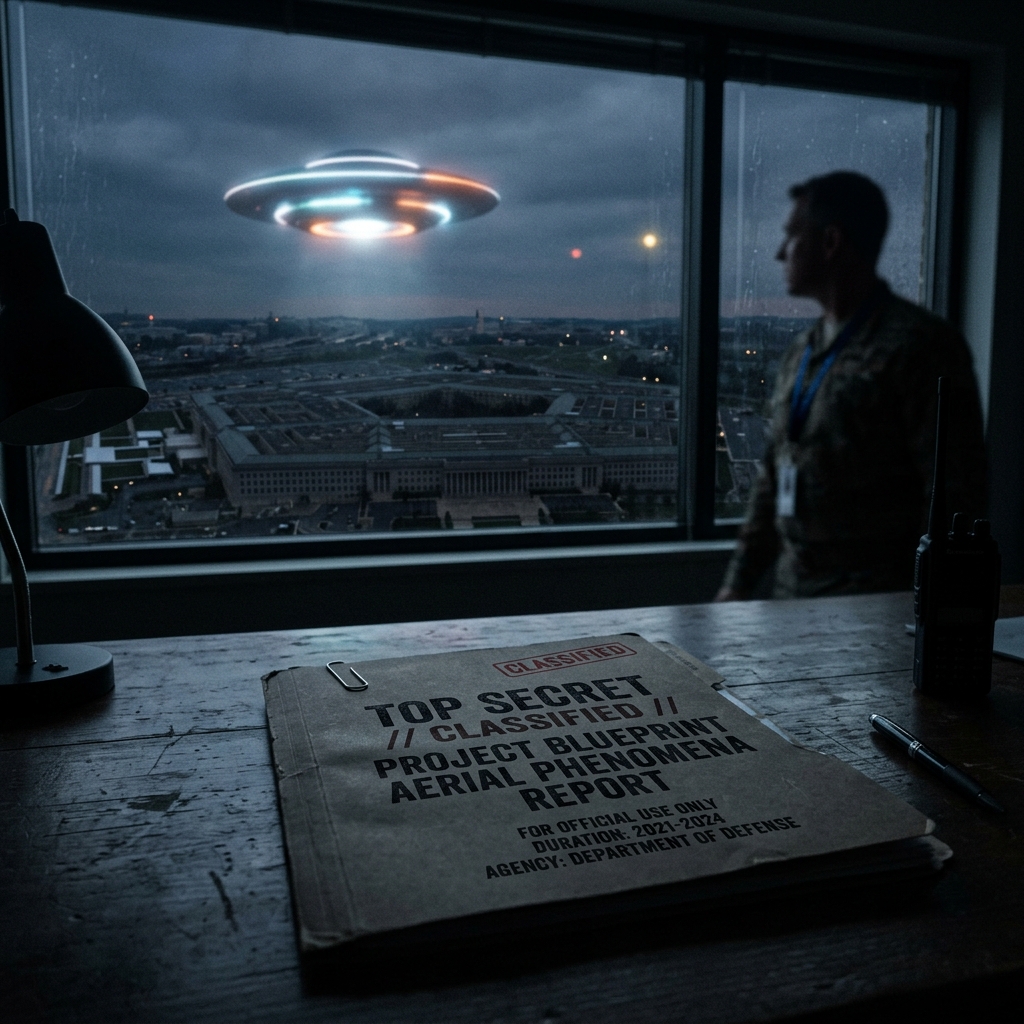
For seventy-nine years, the United States government answered the same question with the same answer: nothing to see here. Roswell? A weather balloon. The lights over the Capitol in 1952? An atmospheric anomaly. The Tic Tac off the USS Nimitz? Pilot error, sensor glitch, optical trick.
Then, on a quiet Friday afternoon, in a corner of the federal internet most Americans had never visited, the Pentagon opened a digital door it had kept welded shut since the Truman administration.
The website is plain. Black background. White typewriter-style font. The URL almost reads like a typo: war.gov/ufo.
What's behind it is anything but plain.
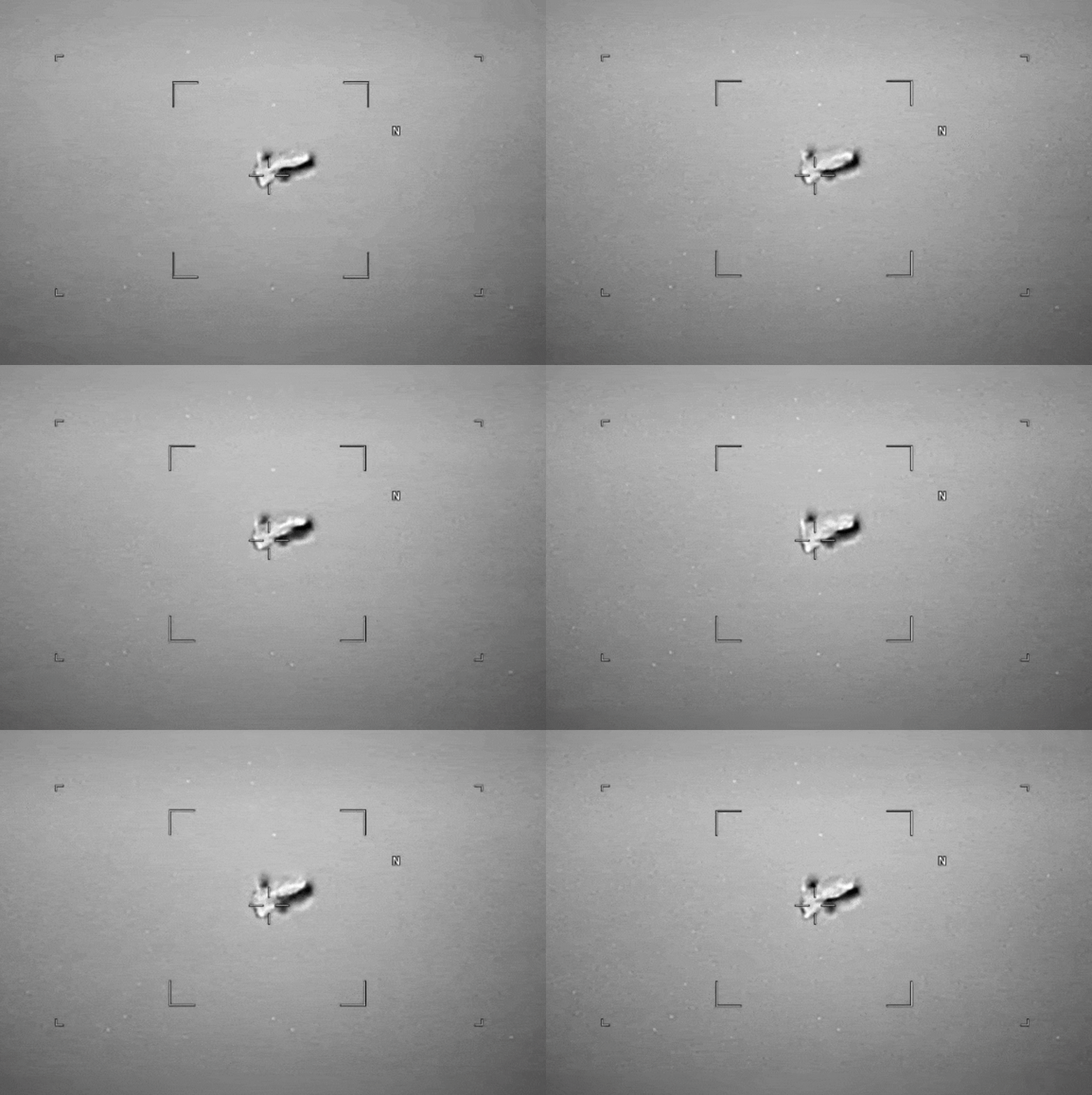
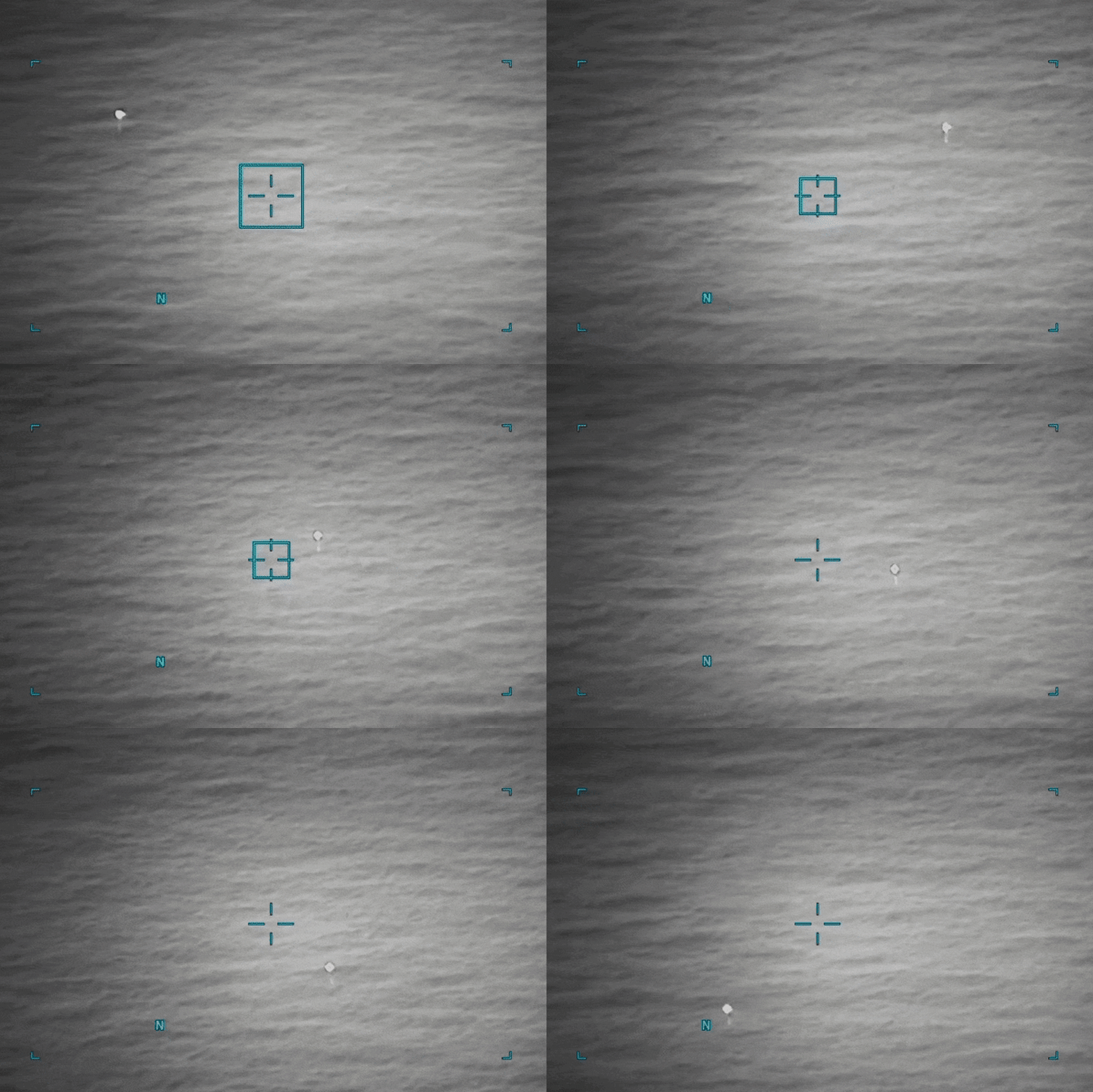
In the first batch, the Department of War — that's the new official name for what we still call the Pentagon — released 162 records: declassified memos, military mission reports, FBI eyewitness submissions, NASA transcripts from the Apollo missions, and roughly two dozen videos showing infrared footage of objects that pilots cannot explain.
The American people, in the words of a senior Pentagon spokesperson, can now access the federal government's UAP files "instantly … no clearance required."
The question is no longer whether the government has been holding things back. The question is: what, exactly, did they finally let go of?
A Quiet Friday, A Loud Disclosure
The release didn't come with a press conference. There was no televised address. Instead, on the afternoon of May 8, 2026, the Pentagon's communications team posted a single line on X: "The latest UAP videos, photos, and original source documents from across the entire United States government are all in one place."
Behind the casual tone was a piece of bureaucratic theater seventy-five years in the making.
The initiative carries an awkward acronym — PURSUE, short for the Presidential Unsealing and Reporting System for UAP Encounters. It was set up after President Donald Trump, in a February 2026 Truth Social post, directed the Department of War and other relevant agencies to begin "identifying and releasing Government files related to alien and extraterrestrial life, unidentified aerial phenomena (UAP), and unidentified flying objects (UFOs)."
His words, just days after the release: "The people can decide for themselves, 'WHAT THE HELL IS GOING ON?' Have Fun and Enjoy!"
Trump's directive forced an interagency reckoning. PURSUE now coordinates the White House, the Office of the Director of National Intelligence, the Department of Energy, the All-Domain Anomaly Resolution Office (AARO), NASA, the FBI, and components of other intelligence agencies — a constellation of bureaucracies that, historically, would rather not be in the same room together, let alone the same database.
Defense Secretary Pete Hegseth framed it bluntly: "These files, hidden behind classifications, have long fueled justified speculation — and it's time the American people see it for themselves."
For the UFO community, that sentence is the closest thing to an apology Washington has ever issued.
Eighty Years of Silence: How We Got Here
To understand what just happened, you have to understand what came before it.
The modern UFO story in America begins on June 24, 1947, with a civilian pilot named Kenneth Arnold and nine "saucer-like" objects flying past Mount Rainier. Two weeks later, debris was found near Roswell, New Mexico. The Air Force initially called it a "flying disc," then walked it back to a weather balloon by sundown. That walkback set the template.
For decades, the official position was that UFOs were misidentifications, hoaxes, or the imaginations of overworked aircrews. Project Blue Book — the Air Force's public-facing UFO investigation — closed in 1969 after concluding there was nothing to investigate.
But the files never really stopped accumulating. They just got reclassified.
The modern era reopened in December 2017, when The New York Times revealed the Pentagon had been quietly funding a UAP study program called AATIP. Then came the Navy's release of three infrared videos — "GOFAST," "GIMBAL," and "FLIR1" — showing objects that defied known propulsion physics.
In 2022, Congress held its first open UAP hearings in over fifty years. In 2023, former intelligence officer David Grusch testified under oath that the U.S. government was operating a clandestine crash-retrieval and reverse-engineering program — and that he knew people who had handled "non-human biologics." The Pentagon's AARO office issued a public denial in March 2024 stating it had found no verifiable evidence of any extraterrestrial technology recovery.
That tension — credible whistleblower on one side, official denial on the other — is the gap that PURSUE has now stepped into.
What's Actually Inside the 162 Files
Here is where the story stops being abstract.
The first PURSUE tranche includes 120 PDF documents, 28 videos totaling roughly 41 minutes of infrared footage, and 14 image files including Apollo lunar photographs and FBI-submitted eyewitness composites. The encounters span from 1947 to 2026. The geography spans the Earth — and the Moon.
The release includes long-classified communications transcripts from Apollo 12 (1969) and Apollo 17 (1972). They are extraordinary. On Apollo 17, Lunar Module Pilot Harrison "Jack" Schmitt described seeing bright particles outside the spacecraft "like the Fourth of July." Mission Commander Eugene Cernan reported watching streaks of intense light for three hours. He compared one bright flash to "a train headlight" passing directly across his vision. According to the declassified Pentagon analysis, Cernan concluded the rotating phenomenon "corresponded to physical objects in space rather than a purely optical phenomenon."
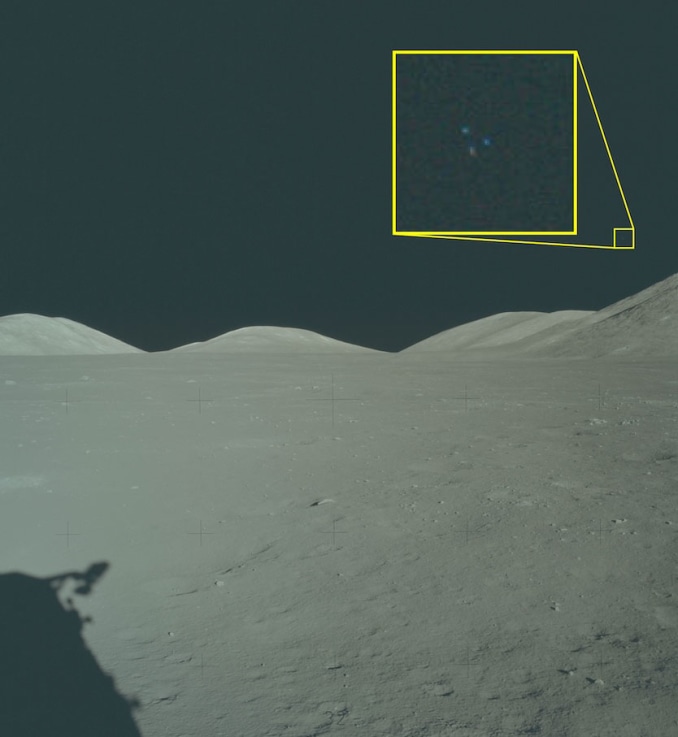
A separate NASA photograph from December 1972 — showing three dots in a triangular formation in the lunar sky — is now under active formal investigation by the Department of War. The Pentagon's own preliminary assessment? The image is "potentially the result of a physical object in the scene." That is the U.S. government, in 2026, officially conceding that something physical was in the sky over the Moon — and they don't know what it was.
The newer files are arguably more unnerving than the historical ones. Military memos describe a "small UAP" observed by U.S. forces in Iraq in 2022. A 2023 incident over Greece captured an object making 90-degree turns at roughly 80 miles per hour — a maneuver impossible for any known aircraft of that size. In Syria in 2024, infrared cameras recorded two "semi-transparent, irregularly shaped orange areas" that appeared and vanished within seconds. There are also recent reports from troops in the United Arab Emirates and Greece, and from a U.S. military operator in African airspace in 2025.
Perhaps the most cinematic entry is a composite image released alongside FBI corroborating reports from September 2023. It depicts an "ellipsoid bronze metallic object materializing out of a bright light in the sky, 130–195 feet in length, and disappearing instantaneously." Multiple eyewitnesses, including a drone operator at a U.S. test site, described the same craft independently. The FBI also submitted 24 separate images of UAPs from the Western United States in late 2025.
The Hidden Details Most Outlets Missed
The mainstream coverage focused on the headline numbers and the Apollo photos. But buried inside the files are smaller details that tell a darker, stranger story.
Of the 162 documents, 108 contain redactions. That's nearly two-thirds. The Department of War says the redactions only protect "the identity of eyewitnesses, the location of government facilities, or potentially sensitive information about military sites not related to UAP." But the math is uncomfortable: a transparency initiative in which the majority of evidence is partially blacked out.
The Pentagon was careful to insert a disclaimer on every military memo, noting that the "descriptive and estimative language" reflects the "subjective interpretation" of the personnel involved. Translation: we're releasing what they said, not endorsing what they saw.
The older files released by the FBI now have fewer redactions than when they were first published. Documents covering eyewitness testimony from 1947 to 1968 have been re-released with previously hidden names, locations, and details visible. For UFO researchers, this is a quiet earthquake. Information that was redacted for half a century is suddenly fair game.
Most overlooked is the structural acknowledgment by AARO itself. The new PURSUE portal supersedes AARO's prior public-facing efforts in both scope and political authority. For the first time, an interagency body answers directly to the White House on UAP disclosure — not just to the Department of Defense. That is a bureaucratic shift with consequences that will outlast any single administration.
Pentagon, CIA, NASA: Who Knew What, and When?
The official architecture of UAP investigation now runs through three pillars. The Pentagon, through AARO established in 2022, is the operational lead — analyzing military encounters, maintaining a sensor data archive, and now operating the PURSUE portal. NASA has historically denied any institutional UAP role, but in 2023 established its own independent UAP study panel, and Administrator Jared Isaacman publicly endorsed the PURSUE release. "We will remain candid about what we know to be true, what we have yet to understand, and all that remains to be discovered," Isaacman posted on X the day of disclosure. The Office of the Director of National Intelligence coordinates the inter-agency review and holds classification authority, while the CIA's archival contributions include reports from the 1950s and 60s — a period in which the agency, by its own admission, monitored UFO sightings as part of Cold War intelligence work.
The institutional fingerprints across the files make one thing clear: the secrecy was never housed in one agency. It was distributed. And distributed secrecy is the hardest kind to unwind.
The Internet Lost Its Mind
Within hours of the release, #UAPFiles and #WhatTheHellIsGoingOn were trending across X, Reddit, and TikTok. The r/UFOs subreddit added more than 40,000 new subscribers in 48 hours. YouTube creators rushed to produce reaction videos. AI image-generators flooded social feeds with hypothetical reconstructions of the Apollo 17 triangle.
(Read also: How the internet reacted to the latest global health scares)
But the most interesting reaction came from former President Barack Obama, who — just days before the disclosure — reiterated that the U.S. government is "not hiding evidence of aliens." That comment, intended to dampen speculation, instead became its own viral moment as people compared it to the very files Trump was about to release.
Online theories ranged from the cautious to the explosive. The UFO community has long argued that governments leak the truth gradually, conditioning the public for a larger revelation. PURSUE — with its commitment to "rolling tranches every few weeks" — fits that pattern almost too neatly.
Where Science and Skepticism Collide
Among scientists, the reaction has been split — but more open-minded than at any point in modern memory.
Harvard astrophysicist Avi Loeb, founder of the Galileo Project, told NewsNation that some of the lunar imagery could be explained by asteroids — but emphasized that the release legitimizes UAP as a field of scientific inquiry. "This opens the subject to scientific inquiry and serious discussion, rather than ridicule," Loeb said. "The way the subject was dismissed in the past — within the scientific community and publicly — is a serious matter that needs attention."
Skeptics, including aerospace analysts and former military intelligence officers, point out that most of the videos remain low-resolution infrared captures prone to parallax errors, lens artifacts, and bird-strike misidentifications. The 2024 AARO report explicitly stated that all investigative efforts concluded "most sightings were ordinary objects and phenomena and the result of misidentification."
But here's the wrinkle: AARO also admitted it could not explain a small residual percentage of cases. That residue — small in proportion, enormous in implication — is the heart of the controversy.
Could It Actually Be Extraterrestrial?
The honest answer is: the files do not prove it. The files do not disprove it. And that is precisely the problem.
What the documents demonstrate is that highly trained military pilots, federal agents, and astronauts — people whose professional credibility depends on accurate observation — have repeatedly reported encounters with objects that exhibit behavior outside known aeronautics: instantaneous acceleration, transmedium travel from water to air, 90-degree turns at high speed, and apparent immunity to atmospheric drag.
There are four prevailing hypotheses. The first is adversary technology — secret Chinese or Russian aircraft, possibly hypersonic. The second is U.S. black-budget projects — classified prototypes unknown even to senior commanders. The third is sensor and perception errors, the AARO default position. The fourth is non-human intelligence — the explanation no government wants to be the first to confirm.
The Pentagon's 2024 report officially rejected hypothesis four. The 2026 release does not endorse it. But for the first time in modern American history, that hypothesis is being formally investigated rather than formally mocked.
Why Did It Take This Long?
Even with PURSUE, the deeper question lingers: if these documents could be released now, why were they classified for so long?
The institutional answer is sources and methods — releasing UAP files might inadvertently reveal sensor capabilities, surveillance assets, or classified observation locations. The cynical answer is bureaucratic momentum — once a document is classified, declassifying it requires effort, political will, and someone willing to take the heat. The conspiracy answer is the simplest: they were hiding something.
The truth is probably an unsatisfying combination of all three. What's different now is that the institutional cost of silence has finally exceeded the institutional cost of disclosure. Congress has demanded transparency. Whistleblowers have testified under oath. The public has stopped accepting "no comment." And a sitting president weaponized Truth Social to force the issue.
What Comes Next
PURSUE is not a finished disclosure. It is a delivery system.
The Department of War has committed to new tranches every few weeks, and tens of millions of documents are reportedly being reviewed. If even one percent of those documents contain genuinely anomalous material, the cumulative public impact over the next twelve months will be unlike anything previously seen.
Three implications are worth watching. First, scientific funding — as legitimacy increases, expect more universities to launch UAP research programs and more grant money to follow them. Second, legislative pressure — the UAP Disclosure Act, championed by Senator Chuck Schumer, may regain momentum. Third, geopolitical ripple — if American disclosure continues, expect Russia, China, the UK, France, and Brazil to follow with their own files. UAP transparency may become a new arena of soft-power signaling.
The Sky Is the Same — But We Are Not
For most of human history, the sky was a mystery we were content to leave alone. That contentment is over.
What PURSUE represents is not the end of the UFO question. It is the first official admission, from the most secretive military bureaucracy on Earth, that the question itself was always legitimate.
The Apollo 17 photograph has been in government archives for fifty-four years. Three lights in a triangular formation, hanging in the lunar sky. The government has not yet explained them. It has only brought them closer to being seen.
And in 2026, "being seen" might be the most radical act a government can perform.
The truth is no longer out there. The truth is on a black government webpage with white typewriter font, and it's loading right now.
Frequently Asked Questions
What are the newly released UFO files? On May 8, 2026, the Pentagon released 162 declassified records — including 120 PDFs, 28 videos, and 14 images — covering UAP encounters from 1947 to 2026. They are hosted at war.gov/ufo under the PURSUE program.
What does PURSUE stand for? PURSUE is the Presidential Unsealing and Reporting System for UAP Encounters. It is an interagency declassification effort directed by President Donald Trump in February 2026.
Do the released UFO files prove aliens exist? No. The files document unexplained encounters but do not confirm extraterrestrial origin. The Pentagon and AARO continue to state that there is no verified evidence of non-human intelligence.
What is the Apollo 17 UAP photograph? A NASA image taken in December 1972 showing three dots in a triangular formation in the lunar sky. The Department of War has opened a formal investigation, concluding the dots are "potentially the result of a physical object in the scene."
Where can I see the files myself? At war.gov/ufo. New documents will be released on a rolling basis every few weeks.
How many of the released files are redacted? 108 of the 162 files contain redactions, intended to protect witness identities and sensitive facility locations.
Sources
- U.S. Department of War — Official PURSUE Portal
- AARO (All-domain Anomaly Resolution Office)
- CBS News — Pentagon begins release of UFO files
- CNN Politics — Pentagon releases initial batch of declassified files
- NPR — UFO files released: Defense Department publishes trove of records
- NBC News — Pentagon releases declassified UFO files
- Fox News — Declassified Apollo mission UFO transcripts
- Wikipedia — United States UAP files