Extremely Painful: Inside Field Marshal Munir's New Doctrine That Just Redrew Pakistan's Red Lines With India
[!IMPORTANT] Key Highlights:
- Doctrinal Shift: Pakistan officially retires "Minimum Credible Deterrence" for a new, more aggressive threshold.
- New Red Line: Future Indian "misadventures" will face an "extremely widespread and painful" response.
- Saudi Defense Pact: A binding mutual defense treaty with Riyadh now acts as a strategic force multiplier for Islamabad.
- Unified Command: The creation of a "Defense Forces Headquarters" eliminates inter-service delays for the first time in history.
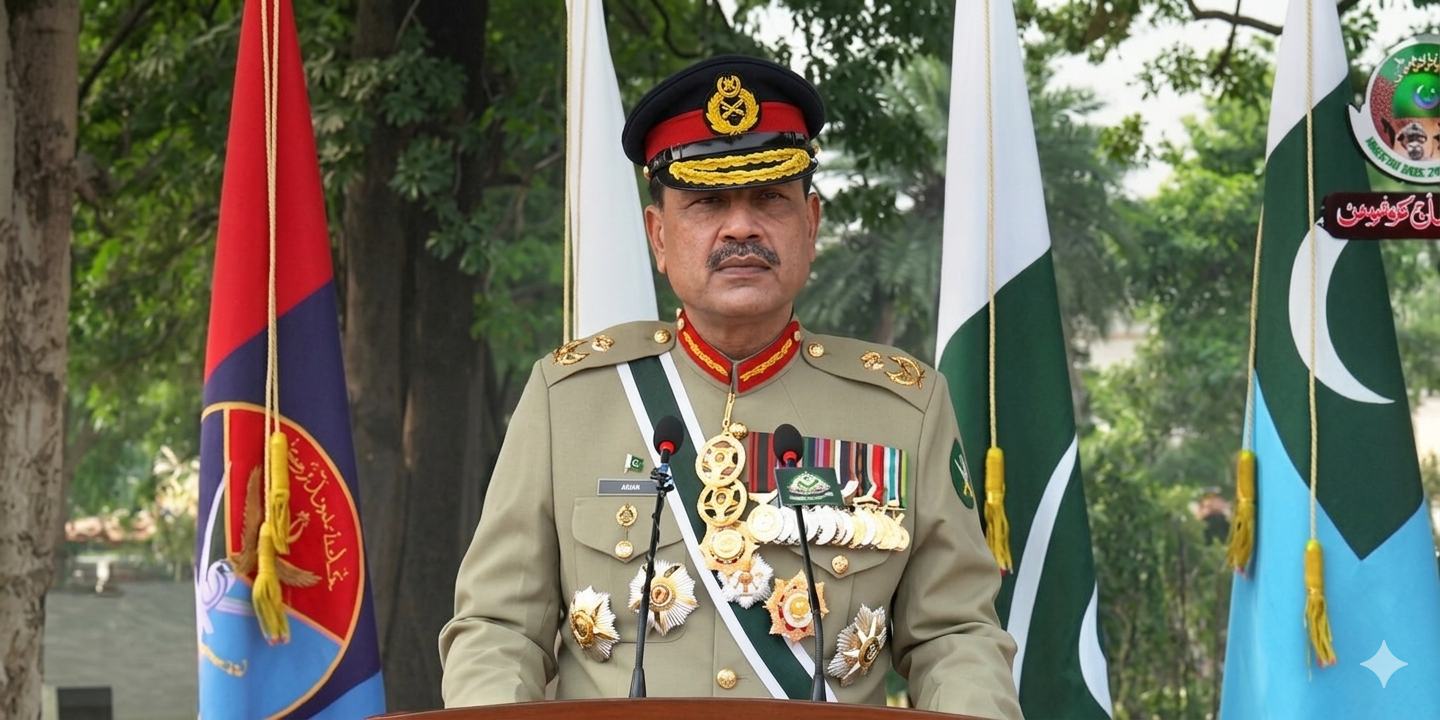
On Sunday afternoon, inside the General Headquarters in Rawalpindi, Field Marshal Syed Asim Munir stood in front of three service chiefs, a row of medals, and a country watching on live television.
He had one job: mark the first anniversary of Marka-e-Haq, the four-day war with India that Pakistan calls a victory.
He did that. But he did something else, too — something that has not yet been picked apart by analysts inside or outside Pakistan, and something that is going to define the next decade of South Asian deterrence.
He quietly retired the phrase "minimum credible deterrence."
In its place, he installed a new one: "extremely widespread, dangerous, far-reaching and painful."
Those words are now Pakistan's official threshold for what happens if India makes another move. And if you read them carefully — slowly, the way intelligence analysts in New Delhi are reading them this morning — they are not a continuation of old policy. They are a doctrinal break.
This is the story almost everyone covered. This is the story almost no one understood.
What Munir Actually Said
Speaking at GHQ on May 10, 2026, marking exactly one year since the May 2025 ceasefire that ended Operation Bunyan-um-Marsoos, Field Marshal Munir delivered the line that lit up Pakistani television:
"Our enemies should know that if any attempt is made in the future to carry out a misadventure against Pakistan, then the impact of war would not be limited, but extremely widespread, dangerous, far-reaching and painful."
In the same speech, Prime Minister Shehbaz Sharif officially declared May 10 a permanent annual day of remembrance — "Youm-i-Bunyanum Marsoos." President Asif Ali Zardari called the conflict "one of the most important chapters" in Pakistan's history. The three men who stood beside Munir — Air Chief Marshal Sidhu, Admiral Ashraf, and the deputy chiefs — represented the unified tri-service command that did not exist in this form before the May 2025 war.
The Pakistani press covered the ceremony. The Indian press covered the threat. The international press covered the rhetoric.
What none of them sufficiently covered is what changed inside the doctrine.
The Old Pakistan Said One Thing. The New Pakistan Says Another.
For three decades, Pakistan's military communication to India operated on a single, deliberately ambiguous concept: minimum credible deterrence. The idea was simple — Pakistan would maintain just enough nuclear and conventional capability to make any Indian attack too expensive to justify, but would not signal an intent to escalate beyond what was necessary to survive.
Minimum. Credible. Deterrence.
Three words. Each one a brake on its neighbours.
Munir's Sunday speech used none of those three words. Not once.
What he used instead was a different vocabulary. "Multi-domain operations." "Long-range precision systems." "Cyber capabilities." "Artificial intelligence." "Rocket Force." "Hangor-class submarines." A "Defence Forces Headquarters" that aligns Pakistan's three services under unified command — a structural reform that, in practice, eliminates the inter-service coordination delays that historically slowed Pakistani retaliation.
He named the new technologies. He named the new structure. And then he named the new threshold: not "credible," not "minimum" — painful.
(Read also: The Pentagon's UFO Disclosure: What it means for global intelligence)
That word matters. In strategic doctrine, "painful" is a deliberate technical term. It signals a posture in which the response is not designed to be proportionate to the attack, but disproportionate to it. Painful means asymmetric. Painful means deeper than the cut. Painful means the cost-benefit calculation in New Delhi's war room no longer ends at the border.
Munir said it once, and he said it on the record, and he said it standing in front of every officer in the Pakistan Armed Forces.
This is not minimum credible deterrence. This is something else.
Why It's Happening Now
The timing is not accidental.
In the last six months, Pakistan has done three things that have fundamentally changed its position in the world.
It signed a mutual defence agreement with Saudi Arabia in late 2025 — the first formal mutual defence treaty Riyadh has signed with any Muslim state since the 1960s. It became the official mediator between the United States and Iran during the 2026 war, hosting the "Islamabad Talks" in April and shuttling Tehran's proposals back and forth from Trump's desk. And it watched as Field Marshal Munir became the first non-head-of-state military leader ever invited to a private White House lunch with a US president.
Each of those events strengthened Munir's domestic position. Together, they created the political ceiling necessary to update Pakistan's deterrence vocabulary without facing internal pushback.
There is also a harder calculus underneath.
The May 2025 war proved one thing on both sides of the Line of Control: ambiguity is no longer working. India's "Operation Sindoor" struck nine sites inside Pakistan and Pakistan-occupied Kashmir. Pakistan retaliated. The conflict escalated faster than either side's pre-war scenarios had projected. The ceasefire, eventually brokered with US involvement, held — but only barely.
What both governments learned was that the old language of deterrence — careful, ambiguous, deliberately vague — had stopped functioning as a guardrail. Each side had read the other's posture as bluff. Each side had been wrong.
Munir's new vocabulary is an attempt to fix that. By replacing ambiguity with specificity ("extremely widespread"), and proportionality with disproportionality ("painful"), the field marshal is telling India: the next miscalculation will not be a small one.
That is either a stabilizing move or a destabilizing one, depending on whether you believe deterrence works better when it's clearly stated or when it's deliberately vague.
History suggests both are true at different times. The question is which one is true now.
The Saudi-Pakistan Defence Pact: The Quiet Force Multiplier
Buried inside Munir's speech was a single line that, in the West, has barely been analyzed.
"The strategic mutual defence agreement between Pakistan and Saudi Arabia," he called it, is "a major diplomatic milestone."
That sentence is doing more work than its calm tone suggests.
For the first time in modern South Asian history, an attack on Pakistan is — in theory — an attack that triggers a Saudi response. The exact terms of the agreement remain classified, but Pakistani officials have publicly described it as "mutual" and "binding." That language is doctrinally identical to NATO's Article 5.
For New Delhi, this changes the math. Any future India-Pakistan conflict now carries the risk — not the certainty, but the risk — of pulling Saudi Arabia into a regional crisis. And Saudi Arabia, post-2024, has reactivated its defence relationships with both the United States and China, meaning the regional risk is also a great-power risk.
That is the architecture Munir has built quietly, while the West has been distracted by Iran. It is the architecture that allows him to use words like "painful" without it being theatre.
What India Is Hearing — And What It's Doing About It
The Indian response has so far been measured. New Delhi reiterated its standing position that it "retains the right to defend itself against Pakistan-backed cross-border terrorism" and reaffirmed its commitment to strengthening the global fight against terrorism.
That is the diplomatic surface.
Underneath, Indian defence planners are reportedly recalibrating around three new realities: a unified Pakistani tri-service command, a Saudi backstop, and explicit Pakistani signaling that future retaliation will be disproportionate. Pakistani defence analyst Yamin recently confirmed that Islamabad is pursuing the longer-range HQ-19 ballistic missile defence system, with induction anticipated later in 2026.
If that system is operational, the Indian Air Force's ability to repeat its 2025 deep strikes is materially reduced. The window in which India can act inside Pakistani airspace narrows. And the cost of any miscalculation rises.
This is what painful looks like when it's translated from rhetoric into hardware.
What This Means for the Next Twelve Months
There are three things to watch.
First, the Indus Waters Treaty. India suspended it in April 2025 and has not reinstated it. Pakistan's effective water storage capacity is approximately thirty days. India's is between one hundred and twenty and two hundred and twenty days. If India formally walks away from the treaty rather than continuing the de facto suspension, Pakistan's "painful response" doctrine will face its first real test — not on the battlefield, but in the courts of public opinion and international law.
Second, the Afghanistan question. Munir's speech included an explicit demand that Afghanistan eliminate terrorist sanctuaries inside its territory, and an accusation that India is "resorting to terrorism" via proxies after failing in conventional warfare. That is escalatory framing. If a major attack occurs inside Pakistan and Islamabad attributes it to an Afghan-based group with alleged Indian links, Munir's new doctrine will be triggered — and the response will be, by his own definition, painful.
Third, the Saudi defence pact's first stress test. The mutual defence agreement has not yet been activated by any real-world crisis. The first time it is activated, the rules of South Asian deterrence change permanently.
A Different Pakistan
For seventy-eight years, Pakistan's strategic identity has been organized around survival. Every doctrine, every alliance, every nuclear posture has been calibrated to ensure that the country exists tomorrow.
What Munir said on Sunday at GHQ was different in kind, not just degree.
He did not speak as the leader of a country worried about its survival. He spoke as the leader of a country setting the price for its peace.
"Pakistan will never allow India's dream to materialise," he said. "We will avenge the blood of every innocent Pakistani."
Those are not the words of minimum credible deterrence.
They are the words of a doctrine that no longer needs to be called minimum, credible, or deterrent — because, in the field marshal's own framing, it has now graduated past all three.
Whether that is a stabilizing development or a dangerous one, the next twelve months will decide.
But the vocabulary has already changed. And vocabulary, in the language of generals, is policy.
Sources
- Geo News — CDF Munir warns of "far-reaching" consequences for any future aggression
- Geo News — 10 key takeaways from CDF Munir's speech commemorating Marka-e-Haq
- The News International — CDF Munir addressing Marka-e-Haq victory ceremony at GHQ
- Pakistan Today — Asim Munir Warns of Painful Response to Future Aggression
- Daily Parliament Times — Field Marshal Munir Warns of 'Painful Consequences'
- Dawn — Latest news from Pakistan, May 11, 2026
- NewsX (India) — Pakistan's Asim Munir Issues Fresh Threat To India
- Kashmir Observer — Pak Army Chief Calls India Conflict 'Battle of Ideologies'
- Al Jazeera — Two wins, two losses: What India, Pakistan have learned a year after war
- SUCH TV — Far-reaching consequences warning on Marka-e-Haq anniversary